
Buying an older race car always comes with a history attached to it.
Laps completed, seasons raced, drivers changed. You don’t just buy a machine—you inherit everything it has lived through.
This became very clear with my Formula Renault 2.0 (2006), a car that has already spent years on track before coming into my hands.
I didn’t discover its first issue under braking at speed.
I discovered it in the garage, during something much more basic: seat fitting.
While setting up the driving position—checking pedal reach, steering alignment, and initial brake pressure—I noticed something immediately wrong. As soon as I pressed the brake pedal, it didn’t just move forward.
It moved sideways.
From the cockpit, the sensation was unmistakable: the pedal was shifting left and right under load. Not flex. Not compliance. Mechanical play.
In the video I’ll include below, you can clearly see the pedal “dancing” even with the car completely stationary.
For a race car, this is more than just unpleasant. Braking confidence is non-negotiable, and any ambiguity at the pedal instantly raises a red flag—especially knowing the car has already seen significant track time.
Time to stop guessing
Rather than ignoring it or hoping it would feel different on track, I decided to do the only sensible thing:
remove the entire pedal box and understand the problem at its source.
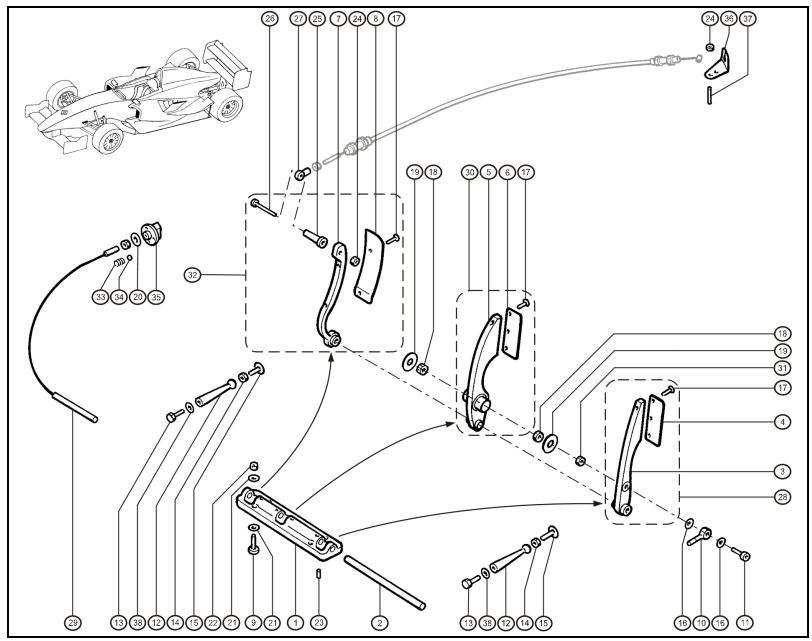
The Formula Renault pedal assembly is mechanically simple and, on paper, very well designed. Looking at the official exploded view helps clarify the architecture:
- Part (1) is the rigid base plate, bolted directly to the chassis and responsible for overall stiffness.
- Part (2) is the main pivot shaft, running laterally through the base and through the root of all pedals.
All pedals rotate around the same axis defined by shaft (2). In ideal conditions, this axis allows pure rotation—no lateral freedom, no ambiguity.
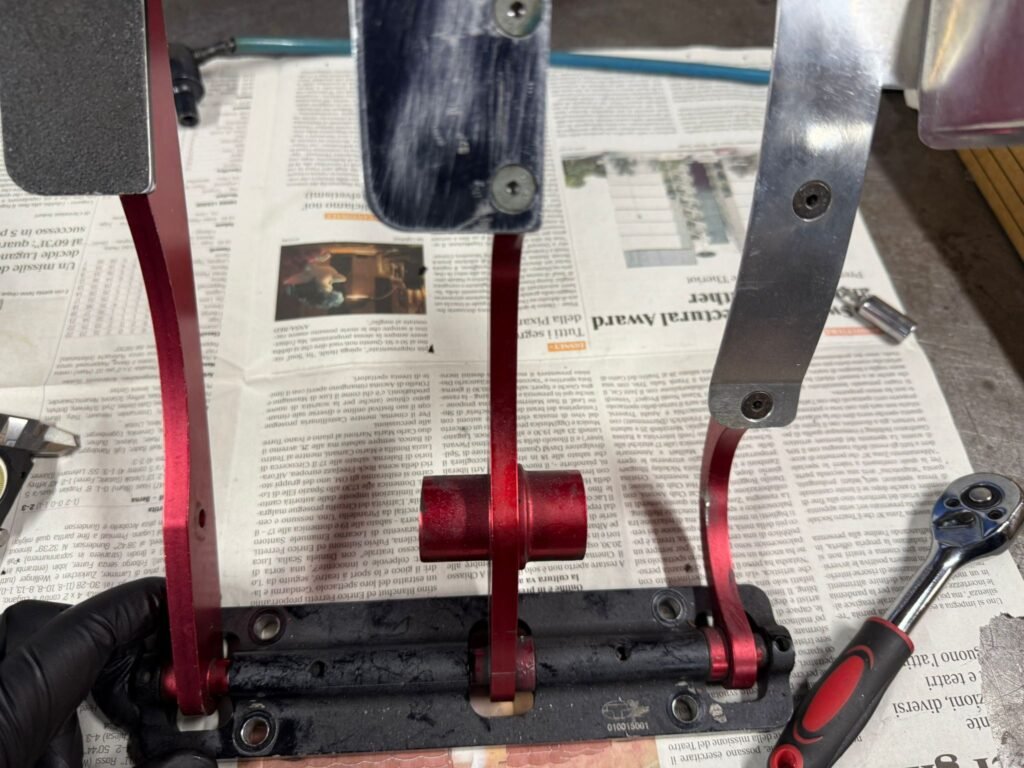
Once the pedal box was on the bench, the issue became clear.
That’s the theory.
What wear does to good engineering
The pivot shaft (2) showed visible signs of wear along the contact surfaces. More importantly, the bushings inside the pedals, which rotate around that shaft, were no longer dimensionally tight. Scratches, scoring, and polished areas indicated long-term friction and material removal over many seasons.
The tolerances involved are extremely small—fractions of a millimeter. But in a pedal system, those fractions matter. A few tenths of clearance at the shaft level translate into several millimeters of lateral motion at the pedal pad.
That’s exactly what I was feeling during the seat fitting.
It’s important to stress that the base plate (1) itself was not the problem. It remains stiff, properly mounted, and structurally sound. The entire issue originates from the rotating interface defined by shaft (2) and the pedal bushings.
This is a classic case where a system still “works,” but no longer works precisely.
Manuals vs. reality
Since this was my first time working on this specific car, I relied on the official Formula Renault manuals. They do an excellent job of showing what components exist and how they relate to each other.
What they don’t really explain is how to remove the pedal box from the chassis in practice.
The assembly sits deep inside the car and is tightly integrated with the brake system. To keep everything clean and avoid unnecessary recalibration, I decided to remove the entire pedal box in one piece, including the brake bias adjuster, instead of dismantling it partially.
That choice meant:
- working slowly,
- labeling every connection,
- avoiding unnecessary hydraulic disconnections,
- and making sure no component was stressed or damaged.
Today, with experience, this would be a much quicker job.
The first time, it took several hours.
But the result was a clean extraction, zero damage, and no need to re-bleed or recalibrate the braking system afterward.
Why this matters
This post isn’t just about a worn shaft or damaged bushings.
It’s about how small mechanical clearances—built up over years of racing—can completely change how a car feels, even before it turns a wheel under a new driver. A few tenths of a millimeter were enough to destroy braking confidence during a simple static check.
It’s also a reminder that:
- buying a used race car means inheriting its wear,
- seat fitting is as much a mechanical inspection as it is an ergonomic one,
- and manuals rarely tell the full story.
I’ll include a video showing the pedal movement and photos of the worn components so you can see exactly where the issue originates.
In the next post, I’ll go through the repair, the reassembly, and—finally—the first proper impressions behind the wheel.
Until then, feel free to ask questions or share similar experiences.
Because pedals should never dance—not even in the garage.